daywefightback

Friday, November 2, 2012

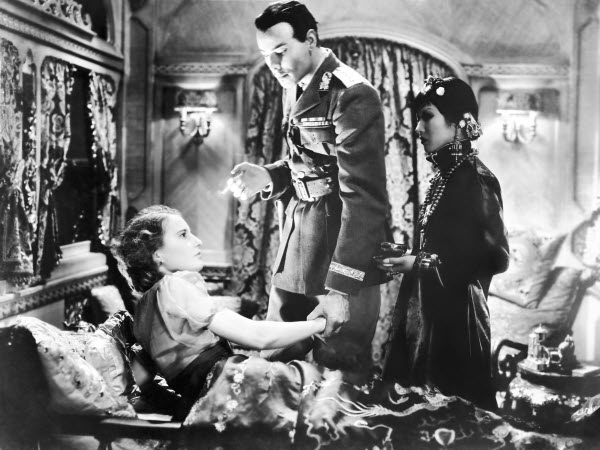
The Bitter Tea of General Yen (1933)

Barbara Stanwyck, Nils Asther
directed by Frank Capra

Capra is so underrated.  Modern critics consider him naive, while during his time he was considered a 'serious' film maker, maybe even too serious.  A source on wikipedia claims that some the the anti-trust legislation which eventually broke up the studio system was little more than blowback from 1939's Mr Smith Goes to Washington.  It upset so many people that Columbia had to launch a propaganda campaign, convincing the public that Mr Smith really was patriotic after all.  That's fodder for a Capra film in itself!

Capra movies are strange because, while he clearly was worldly-wise enough to understand the characters and their motivations (and this is some dark stuff!), he is also fiercely idealistic.  Megan, the main character, a proselytizing American in China, is foolish and naive, and yet the film takes her side; we are supposed to identify with her.  Some of Stanwyck's lines are corny and even racist, and yet Capra seems to realize this; it plays out in the story; Megan is a fool.  There's an ambiguity there which I don't yet understand.

I didn't understand the attraction between General Yen and Megan.  Some women find cruel people sexy.  I don't.  The General Yen character was all cold and passionate and scary kind of like the warrior character from that Kurosawa movie The Idiot.

The producer did a beautiful job of recreating China on the studio lot; the costumes are exquisite.

It's a difficult, slow movie.  A good deal of it is quite dull and formulaic; although I'm sure that the love-between-races theme was daring enough in its own time.  Of course the rather trite romance is something of a cover-up for a subtler dramatic exploration of the meeting of East and West. You can enjoy Bitter Tea on different levels, but it takes effort.

Panic in Needle Park (1969)

Al Pacino, Kitty Price
directed by Jerry Shatzberg

method acting at its best.  these kids knew what they were doing.
Panic in Needle Park is the definitive heroin movie.  It's even more definitive than Trainspotting, although that one wasn't so bad either.  It was a one hit wonder from former photojournalist Jerry Shatzberg, and featured Al Pacino in his first starring role.

This is probably the most psychologically traumatic film I have ever seen.  The movie is trying to make you very, very miserable, so miserable that you begin to feel physically sick.  This is not because the director is mean, but rather that he is trying to do something very difficult; he is trying to describe a life lost to addiction, he is trying to show how far people will degrade themselves just to get that single 'high'.  And he also shows why the reasons people want to get high.  Ingo Preminger did a pretty okay job ten years earlier in his Man With the Golden Arm, but Shatzberg one takes it a few steps further.

This could have easily been tacky and trite and awful like some of those blaxploitation movies coming out around the same time, but it wasn't.  I don't know if it was because Shatzberg knew his characters and evinced a certain sympathy for them (the people shooting up are... really shooting up), or because the acting talent was straight-up incredible.  I wonder too if it had something to do with the zeitgeist of the times; people were broke and frustrated, and really learned to make it work with what they had.  Pacino especially exudes restlessness.  There's a spirit of rebellion through these 70's films which I admire so much.

Wednesday, October 31, 2012

Up In Arms (1944)

Danny Kaye, Dinah Shore, Dana Andrews
produced by Goldwyn


and... IT WAS!!
Danny Kaye made some really shitty movies.  After I'd seen a couple of his flicks I did a google search to find a bio, and most of them read, "Danny Kaye was absurdly talented..."  Why mention that a guy was talented?  Shouldn't his work speak for itself?  No one writes, "Elias Kazan was a genius of film and theatre".  Or they do, but they're more likely to say, "Elias Kazan directed award-winning classics such as...". 

Up In Arms vacillates between brilliance and stupidity; one moment you have a zoot-suited Kaye surrounded by twelve gorgeous Goldwyn girls sipping a milkshake in a psychedelic dream sequence, and then fifteen minutes later he singlehandedly captures a Japanese batallion in a physical comedy act so dumb it wouldn't impress a five year old.  According to bio I read, Kaye's wife had some words with Goldwyn over the quality of the script, but he ignored her.  Which is strange, come to think of it.  Goldwyn pours all this money into costumes, sets, and technicolor film and yet he can't hire a better writer?  Don't get me wrong, I love my HD rip of Walter Mitty, it's just so pretty!  And yet, so many missed opportunities...

Dinah Shore is a real draw for this one; she's got sass, spunk and a great voice.  She needs all she can get; like Kaye, she's not exactly working with quality material either.  I don't think I've made it through her first number, ever, which I somewhat regret because I think the lyrics have something to do with the story.   The second song she sings isn't too bad though; she spices it up pretty good.  I like the spirit fingers at the end.

Constance Dowling plays the pretty girl, and she does a great job.  Dana Andrews plays the best friend, and he's solid as always.  The sets are nice and there are plenty of perfectly manicured beautiful women standing about in bathing suits (Dana Andrews excuses this with a witty aside).

this picture has absolutely no dramatic significance whatsoever
The best part of Up In Arms is the Broadway-style musical numbers.  I'd never seen a scat number before I saw this movie, probably because Goldwyn had no taste, didn't know he didn't have any taste, and while he hired all these great jazz talents to work together in these movies, they didn't scat because he wouldn't let them because he didn't like it because he had no taste.  I am not making this up, you can read all about it in this book here.  Kaye himself never scatted again until 1959, when he had his own production company and could call the shots.

Up in Arms is weird, campy, stupid, inspired, and has people singing and dancing in it, which is pretty much everything I like in a movie.  And that moment when Kaye screams "NOOOOO!!!"  and runs up the theater lobby staircase is just priceless.  Yes!
Monday, October 29, 2012

Spellbound (1945)

Ingrid Bergman, Gregory Peck, Hitchcock

My new favorite cinephile Matthew Coniam made a dreadful analysis of this movie in his blog Movietone Cameos; I'm pretty sure he's got it all wrong.  It's moments like these when I remember why I spend all my time alone... I'm a weirdo!  The other two commenters agreed with him as well.

Spellbound is pretty clearly a (subtle) satire on Freud.   How could you not snigger to yourself in that final psychoanalysis scene?  As a plot device, it's completely absurd, and Hitchcock knew it.  Also, the Dali dream sequence was totally awesome and random, and I don't know what Mr Coniam was bitching about.  I'm not as into Dali's stuff like as of my hipster friends, but plus ten coolness points to Hitchcock for getting him in on the project.  Or is that the producer's job?  Well, kudos to Selznick, then.

Alfred Hitchcock was a funny man.  If you ever got to see his television show, you'll know what I mean.  The stories are mostly run-of-the-mill B-movie fare and so less interesting.  What's more interesting are the kind of actors he chooses and the kind of scenes he shoots and so forth.  I don't know much about the technical stuff, but I couldn't help but laugh cynically to myself watching these ridiculously good-looking, quintessentially suburban, outrageously American couples whining about how hard they were working to get that next promotion so that they could move out of the streamline and into a real house, while secretly planning to murder each other or something equally sordid.  Not unlike that Gene Tierney flick Leave Her to Heaven where the look is all Lubisch, bur the story itself is film noir.

the famous dali dream sequence
I don't remember much of this movie except that I was surprised to find out that I actually liked Gregory Peck.  He was actually a good actor and likeable.  I remember as a kid being force-fed the film To Kill A Mockingbird in English class, and what's worse, having to listen to people tell me what a great and profound movie it was for years to come.  All I remember is that the movie and the book were really different, and the movie fucked up the book, and, if it wanted to work as a cohesive dramatic unit, it needed to either focus on the racism story or the recluse story and not both.

Sunday, October 28, 2012

The Purchase Price (1932)

Barbara Stanwyck, George Brent
directed by William Wellman

she wants it, but he knows better.
it took forty years for movies to become this honest again.
A surprisingly good B-movie from solid early talkie stars Stanwyck and Brent.  Stanwyck is the nightclub singer who gets in a jam, so runs away to Sasketchewan as a mail-order bride to farmboy George Brent.  But the real drama lies in the post-marriage, surprising prescient battle-of-the-sexes between Stanwyck and Brent.  Not a great melodrama by any standards, but worth watching because it's old, and the subject matter is unusual.

Director William Wellman produced some pretty entertaining flicks back in the day, entertaining if only they were so inappropriate.  I had a good laugh with my friends the first time through Night Nurse (1931), which is also a very stupid movie, but funny for the same reasons.

It's interesting that, although Purchase Price was filmed during the depths of the Great Depression, there are no references at all to, "the state our country's in", indeed, it seems the only time you hear these statements in classic movies is, like, in Mr Deeds Goes to Town, probably in the context of a simple, everyman Joe decrying his countrymen's moral decay.  Healots!  A nice respite from those assholes on CNN and Fox who won't shut the fuck up about how bad our economy supposedly is.  Dedoimedo is probably right; it's probably a hoax by the one percent to get the rest of us to accept lower wages.  Fuck you, society.

This was such a nice movie.  Wellman could have chosen to have gone overboard, but he only does so when it's funny, and keeps it sweet and subtle when it counts.

Thursday, October 11, 2012

Holiday Inn (1942)

Fred Astaire, Bing Crosby
Irving Berlin songs

Certain snobs on certain movie sites will claim that Holiday Inn is the better version of White Christmas, because it is the original, and therefore... better.

It actually is better, in a way.  The story is tighter, and somewhat more daring.  The songs are consistently of a better quality (I never did like that 'Sisters' song, and they sing it, like, three times).  And although the why of Bing Crosby's career will forever be a mystery to me, he was slightly more bearable in the early 40's.

Unfortunately, neither Bing Crosby nor Fred Astaire can act (although Bing holds a slight upper hand here).  Should you ever watch a musical for a great dramatic performance?  If you think the answer to that is 'yes', then you should probably get your head examined.  Still... it's hard not to make comparisons to the great Donald O'Connor, and, yeah, Gene Kelly too, who both had great screen presences, and were fantastic dancers as well.  Not to mention, they could both really belt a tune.

That 'Abraham' blackface number was a little uncomfortable to watch.  I don't really get blackface.  I hear it's racist, and it feels racist.  That 'Abraham' number felt pretty racist.  I was glad when it was over.

Bing convinces his girlfriend to wear blackface so
that Fred won't make any moves on her

Asides from the very good musical numbers, Holiday Inn doesn't have too much to recommend it.  It's corn, but it's bad corn.  Did it make me feel good?  Sort of.

White Christmas is good corn, and has better talent.  I don't particularly like Astaire, nor Crosby, nor that blonde girl who played the lead role whose name I have forgotten.

At least it was entertaining.  I'll give it that much.  Lots of movies don't even manage that.

Thursday, October 4, 2012

I Love Melvin (1953)

Debbie Reynolds and Donald O'Connor reunite after Singin' in the Rain to make this little gem.

we are the gentlemen of the press
yes we are, yes we are yes indeed indeed we are

Musicals get a really bad rap, but that's probably thanks to those overblown spectacles of the early sixties -- think Sweet Charity, Sound of Music, and Bye Bye Birdie.  Yes, Rogers and Hammerstein wrote some great numbers, and yes, Shirley MacLaine was a fantastic actress back in the day, but overproducing these shows turns them sour.  Perhaps this is because musicals are so fake in the first place, and so we prefer not to be distracted by elaborate sets, dresses which scream for attention, perfectly manicured chorus girls mugging the camera, et cetera...

The point of musicals is to be cute and light and not make you think too much.  They're always best if the songwriting is good and if the leads know how to dance.  Sometimes, song and dance numbers can be really good!  Fortunately, they hired the right people for this one.

oh where oh where oh where did you learn to dance?
 
I was surprised by the subtlety of the acting; Donald's never seemed a guy to take himself too seriously, and when he gets a clever or funny line, he doesn't milk it for all it's worth.  This is a good thing, but I found myself doing a double take at certain bits; I think I expect actors to ham it up a bit more.  Debbie Reynolds is sweet and likeable, and she can dance too!

Quite frankly, I'm having a hard time remembering how the story goes, but that's not the point, and the director was smart enough to not bring too much attention to the rather formulaic plot.  I love movies where they don't try too hard and just let the film ride on its own merits.  It Should Happen to You was another one like that.


The morons at imdb give this a rating of 6.5/10, which is probably because they have no taste.